Monday, July 28, 2014

Friday, July 18, 2014

Thoughts about Storytelling

I saw Dawn of the Planet of the Apes yesterday. I walked in intrigued because of the favorable reviews it had garnered; one critic even dared to compare it to The Empire Strikes Back. I walked out disappointed. The atmosphere, setting, and special effects were all fantastic, but the story and characters were bland. The writing was lazy and devoid of original thought. Every complication in the plot had a stock solution and the movie went for the low hanging fruit. There was no suspense. Every character played their part in the predictable way. My criticism isn't simply because the audience knows were the larger setting is going - we all know the apes take over the world - eventually. The writers decided to trod out every trope they could about two cultures that mirror each other and eventually come into conflict. There was one interesting moment in the movie, but I don't want to spoil anything for those that are interested.

Leaving the movie I began to think about the comparison to Empire. What made Empire a beloved movie and story in the upper echelon of cinema? Admitably, I was like 10 when I saw it, but why does it stand up when Dawn seems to fail? The movie has a sense of danger. Almost every scene in Empire pushes the protagonists deeper into the shit. It's not enough that the Millennium Falcon has to evade the Empire, it also has to escape from the inside of giant space slug the were accidentally hiding in. The plot twists. Han, Leia, Chewie, and the droids make it Cloud City to find Han's friend Lando, but it turns out he's made a deal with Empire; of course, there's also Luke's big revelation.

You're players are probably fans of the same things you are, so they're probably familiar with the same plot twists and devices you are. A good to shake things up ask yourself: "What if?" Asking what if is one of the most important tools of fantasy and science fiction. Take the scenario you've been working on and look for different ways to explain what's going on. A common situation for a good king to fall under the counsel of a power-hunger adviser. Usually the adviser has some connections to the evil cult, in order to drive up the drama when the players finally confront the adviser. What if the cult wasn't devoted to a demon, but a fallen angel instead, looking to get back into good graces? Maybe the angel doesn't give a damn about getting back into graces of their deity, and want to start their own holy city? What if the angel wasn't fallen, what if it was a perfectly respectable angel trying to subtly fix the injustices caused by the "good" king through influence rather than direct action?

Something else you can do is think about how to add another layer to danger. How do you keep you players on their toes? Adventures should be simple walks into dungeons. The players should be walking into the unknown. Create a list of things that the characters can know when they walk into the dungeon, then a list of things that you can foreshadow as they make their way through the dungeon, and finally a list of things that you're going to surprise them with. It doesn't have to be a long list, though it depends on the size of your dungeon. Start with ten items altogether between the three lists.

Monday, March 10, 2014

Friday, July 12, 2013

Dwarven Radios and Elven Light Blubs

Geoff Manaugh from BLDG BLOG posted an interesting article about the artistic endevours of Ryan Jordan and Caleb Charland called Alternative Inputs. Essentially, Ryan Jordan is an artist who led a workshop about constructing crude amplifiers out minerals like pyrite and crystals based on the Adam's crystal amplifier.

(From Jordon's Derelict Electronics)

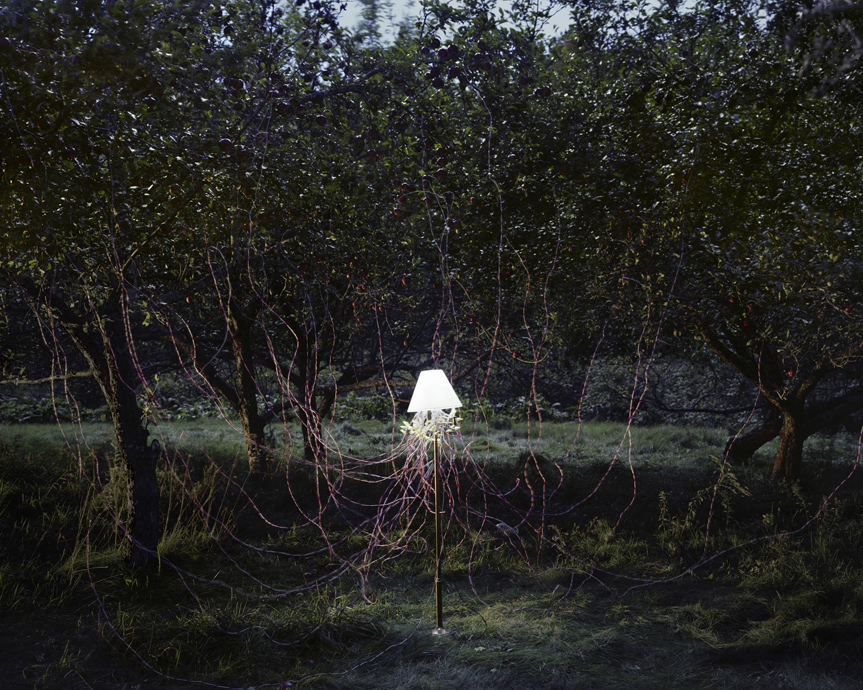
Caleb Charland is an artist that makes installations focused on biological batteries creating light in some way, particularly by powering lamps. 

(From Charland's website)

This sort of primitive take on technology got me thinking. They seemed to fit well with the sort of technology that dwarves and elves might develop. 

I can see dwarves using these pyrite-and-crystal-based radios in their caverns. With a little tweaking these simple amplifiers could be used as microphones. So only could they be used for communication, they could also be used as surveillance. By setting these devices up they could keep tabs on outer parts of their territory for intruders. 

In another article called, Electric Landscapes, Manaugh talks about how if we used landscape to create electricity it would probably be in marsh environments, but this are elves and fantasy we're talking about so whatever. The elves have bred special trees that contain bacterial strains that are especially adept at generating electricity. They have these trees growing at the centers of their cities. Power lines stretch out and criss-cross through the trees giving elves electric starlight even on the cloudiest of nights. 

Sunday, May 5, 2013

The Broomway


The Broomway is three miles of murky, foggy, muddy, coastal wasteland that disappears during high tide. I'm just going to leave these here for your perusal:

The Xenotopian Impulse


Walking the Broomway


Saturday, May 4, 2013

The Grey

Looks terrible, doesn't it?

Back in 2012 and hot off the steamy shit pile that was The A-Team Liam Neeson and the director of The A-Team, Joe Carnahan, put out The Grey. When I first saw a trailer for it, and each subsequent viewing in between things I wanted to watch, I thought it looked like a terrible action movie that was cast in the movie abyss that is January. I'm not entirely sure what put it in my radar again or why I decided to watch, but damn, was it impressive.

The movie is about of group of men who work on an oil rig at The-End-of-the-World, Alaska. The movie starts with Liam Neeson's character, John Ottway, narrating a letter he was writing to his ex-wife about how much he hated his life and how he is going to kill himself. He talks about how he's surrounded by terrible people and there's shot of a bar fight. At that moment I realized this was going to be a D&D movie without magic and swords.

Once the environment and Ottway's character has been established, he gets on plane going back to Anchorage. Mid-flight the plane goes down, and in the midst of snow, burning metal, and broken bodies, a group of men must survive in the harsh wilds of Alaska. Though, harsh is truly an understatement when your looking out at the desolate grey wastes of the tundra. Then things go from bad to completely fucked when Ottway is attacked by two wolves in the middle of the night.

The wolves are like an awesome combination of the velociraptors from Jurassic Park and the xenomorph from Alien. It's a man-versus-nature, survival movie that's comparable to Jaws. Where Jaws had a charm and wit to it, mainly thanks to Richard Dreyfuss, The Grey is a lot more serious and bleak. It's a meditation on the why we choose to struggle when faced with such terrible odds and no real purpose. It's also excellent inspiration for designing wilderness adventures.

The movie gives a great sense of how to challenge players in the wilderness. From the bitter cold to the lack of oxygen. It shows how even falling into river can bring a great sense of drama. I wish I could share more, but I don't want to give any spoilers. Just watch the movie!

There's something terrifying about using normal animals, like wolves, for something greater than random encounter fodder. If you can make your players tremble after fighting mundane animals, think about the possibilities once magic gets involved. If your players every begin combat with, "It's alright, they're just..." you're not doing your job as a DM. They've either seen it enough times that it's boring, or you've made combat predictable. The wilderness has "wild" in for a reason. Don't be afraid to take away some of the safeties. It's okay to thrill your players. That's the point of combat. To quote one of the many excellent monologues in The Grey, "What's wrong with a little fear?"

Saturday, April 13, 2013

Dungeon as Narrative: Rethinking Storytelling


Like a lot of people, you probably got into GMing, because you want to tell stories. You’re probably avid reader of science fiction and fantasy, maybe even an aspiring novelist, and you want to try your hand at writing something. You start developing your world, fleshing out realistic NPCs, and tweaking the minute details. You probably spend a great deal of time making sure every aspect of your world has a compelling backstory. Stop right there.

Your players don’t care. They don’t care that you’ve sweat, cried, and bled to make sure that your world’s history and inhabitants are fully developed and interesting. They don’t care that you’ve constructed character arcs for them that challenge their morals. They want to murder the ever-loving hell out of imaginary goblins, dragons, and Lovecraftian horrorterrors. This is their playground of kill. Yes, even the ones that are polite enough sit there and allow themselves to be railroaded. They aren’t as interested in your story as they are in making their own.

Think about how you interpret the word narrative. When the average person thinks of a narrative, things like novels, plays and, depending on their age, video games come to mind. The problem with our thinking is that pen&paper RPGs aren’t like other storytelling mediums that we’ve had experience with. The players are active participants in the story and they have an infinite number of options, unlike novels and video games which railroad the reader and player. So the game’s narrative can’t be constructed like a novel or a video game. At any moment, a player can choose to make their character walk away from an adventure hook or kill an important NPC. That’s a lot of power, and it needs to be respected if you want to tell an interesting story.

Narrative doesn’t have to just be transmitted through social interaction between the quest-giver and the PCs. Narrative doesn’t have to be the stuff that happens before and after the quest. Narrative is the quest. Narrative is the dungeon. Narrative is the random encounter. Narrative is the treasure. Narrative is participatory. There isn’t one person at the table telling a story, each person at the table is telling their own story. It’s the GM’s job to reconcile the differences and keep all the plates spinning.